“Easy Job”
by India Sawh
Originally printed in SORRY Magazine (April 2026).
Three years after I graduated from the most prestigious law school in Canada, I asked my dad to help me get a job at the shittiest mall in Toronto. My therapist had advised me to find an “easy job” that would get me out of the house to escape the debilitating depression I’d fallen into following my mom’s fatal fentanyl overdose.
I was over- and under-qualified for all the indie bookstores and clothing boutiques I applied to, having only ever worked “hard” jobs. So I did what many of my law school classmates had once done: I asked my father to put in a good word for me with his influential friend.
The friend was Rocco, the owner of a cellphone store in the Dufferin Mall, a shopping centre in Toronto’s west end whose landmark stores include the discount grocery store No Frills, Walmart, Toys“R”Us, and a dozen purveyors of phone plans.
My dad met Rocco in the early 2000s, around the time my mom and I were surviving on mashed potatoes. My mom had been fired from her last job for stealing money to sustain her cocaine and Urban Outfitters problem. She was twenty-seven and I was six. We lived three subway stops from the Dufferin Mall. We had a tab at the corner store for milk and cigarettes because my mom was always “losing” her debit card. At the start of every month, we lowered the volume on Scooby-Doo and sat still as snails as we waited for the landlord to give up knocking.
Though my parents were separated, my dad did his best to support us. Though he didn’t have much money, he did possess a lot of West Indian charisma, which resulted in friends in high places. Once, he dropped off a bag of frozen french fries which was certainly not meant to exist outside the freezer of a KFC. He helped my mom get a job at Rocco’s store, and gradually our dinner options improved.
Now here I was, two decades later, nearly the same age my mom had been, asking him to do the same for me. I had enough savings to afford groceries. But five months had passed since her death, and I still struggled to get out of bed and brush my teeth and toast toast.
For nearly a decade, I had witnessed my mom sink deeper and deeper into opioid use. Eventually, I stopped interrogating her lies, overlooked incoherent text messages, and started saying “love you” at a frequency I hadn’t since I was ten.
None of my mental preparations mattered on the sunny May morning when I answered a call from my younger brother and heard “Mom’s dead.” I howled and collapsed onto the floor.
In the aftermath of her death, I became convinced I could bio-hack my way out of grief. I spent hours a day researching anti-stress supplements, dragged myself to yoga classes, and stopped eating because I thought everything was poisonous to my adrenals. Naturally, my panic worsened. I opened my eyes each morning terrified to spend another sixteen waking hours in my brain. For the first time, I understood why my mom had used drugs. That thought scared me enough to seek psychiatric care.
By fall, I had stabilized. Returning to lawyering felt impossible, but I knew my therapist was right when she said structure and routine were imperative to my recovery.
At first, Rocco dismissed the idea, claiming I was too overeducated. But, he came around. He happened to be looking for seasonal associates for the holidays.
“I owe your mom a lot,” Rocco told me during my interview. “She was a big help to the store.”
“Really?” I said.
“And her hair—it was incredible. Kind of like yours,” he said, floating his hands around his head in the silhouette of my long curls.
My mom was possibly the only white woman on whom long dark dreads looked at once natural and ethereal. It was impossible not to notice her.
“Thursday work for your first shift?”
On Thursday morning, I rummaged through my closet for a button-down. I looked at myself in the mirror and realized that the last time I’d worn this shirt I’d been a lawyer with a mother.
*
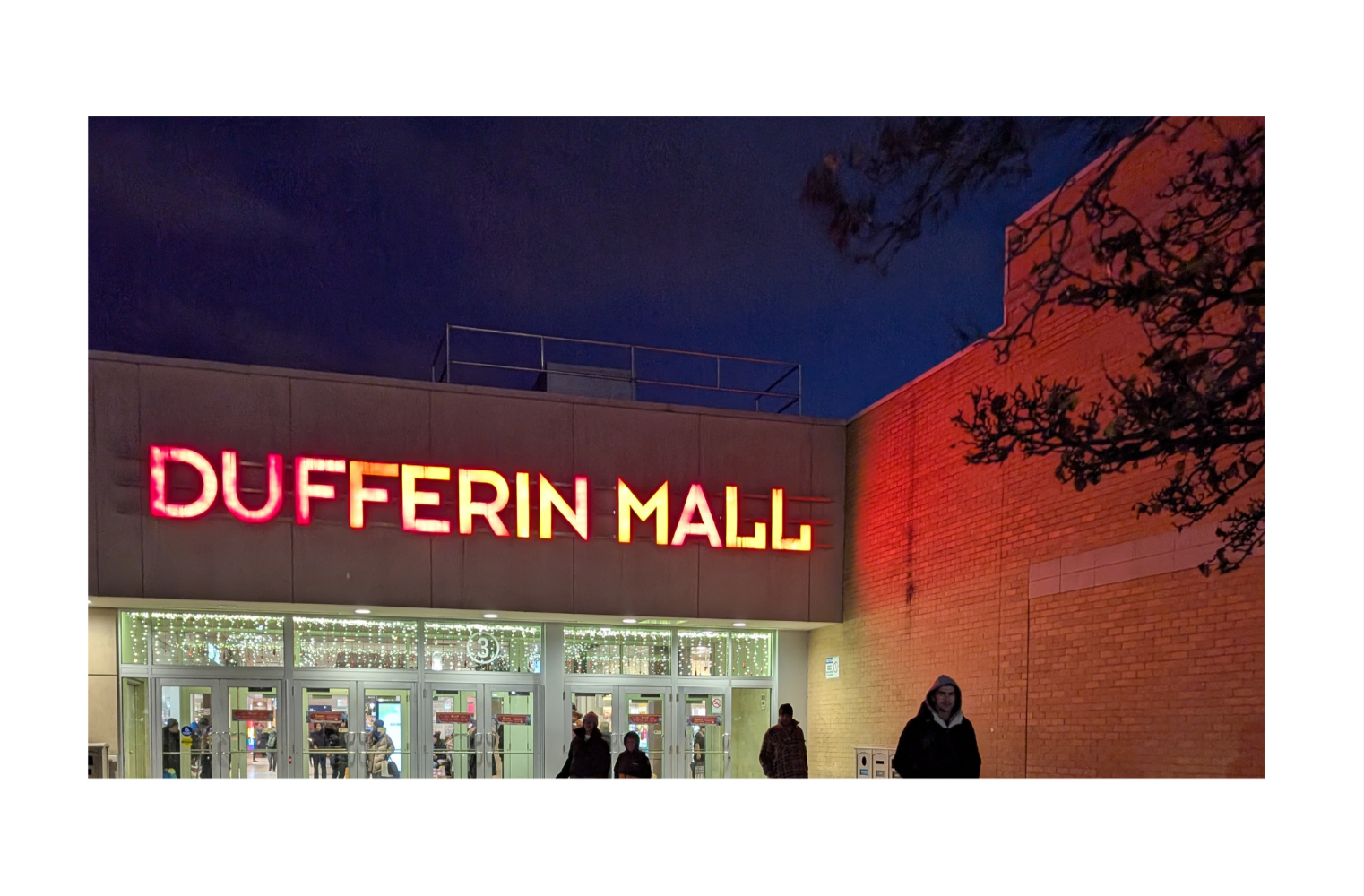
I paused in front of Dufferin Mall’s greying entrance and debated going back to bed. It looked the same as it always had with its idling taxis, flitting pigeons, and neon-red marquee.
In a city colonized by natural wine bars and espresso-based cafés, the “Dirty Duff” remains mysteriously un-gentrified—even as construction has begun on a six-building, mixed-use “masterplanned community” across the street. Stepping through the Dufferin Mall’s sliding doors is like a portal to the Toronto of my childhood.
Which is why I’d spent most of my twenties avoiding it.
Every child of an addict has a coping mechanism. Mine was to bulldoze the drafty, peeling life my parents had built for me and replace it with something shinier: I became the girlfriend of a kind, wealthy white man, travelled to Europe at least once a year, and always had enough money to grab an Americano or glass of orange wine. At twenty-two, I began law school at the “Harvard of the North.” I sat in class, learning contracts laws from the professor who’d literally written the book on it, and wondered if they’d admitted the right India. At faculty events, I mingled with renowned scholars, Bay Street lawyers, and judges over bites of smoked salmon canapés, thrilled to have been admitted into this world but terrified I’d blow my cover.
The year I graduated, my partner and I bought a seven-figure three-story house located five minutes from one of the cramped apartments of my childhood. What had once been a neighbourhood accessible to single moms was now affordable only to those with at least two incomes and one inheritance.
The day we got possession of the house, I lay on the hardwood floor of our empty living room and felt conflicted. On the one hand, I was vindictively pleased that the area I’d been ashamed to grow up in had become a place people fought bidding wars over. On the other hand, I knew that the vibrancy that had attracted investors was rapidly evaporating—and I had become part of the problem. Within two years of buying my house, both of my parents had been priced out of the neighbourhood and displaced to the city’s outskirts.
Perhaps I shouldn’t have been surprised, then, when my identity crisis came knocking, wanting to know whether I was truly happy in this relationship, this career, this house, this life. Eventually, I was forced to answer the door and face the truth, which was that, despite having everything I ever dreamed of, I was miserable.
After many teary months, my partner and I agreed to separate. My mom’s death arrived four days before I was meant to move out of the matrimonial home, heartbroken but thrilled by the possibility of building something different.
Six months later, as I stood before the Dufferin Mall on the morning of my first shift, I’d done just that. I now lived in a slanting one-bedroom attic apartment with a family of mice, washed my dirty clothes at the laundromat, and relied on the GoBus to see family. It was only a matter of time before I ended up back in the mall, the one place from my childhood that still made me shudder. The tagline wrote itself: A grieving young lawyer is forced to reckon with her traumatic past when she accepts a job at the same cellphone store where her now-dead mom once worked.
A woman exited the mall, and a cocktail of Cinnabon, squeaky plastic, and old frying oil whooshed through the sliding doors.
“No way out but through,” I muttered, stepping inside.
I wove through the mall, past the old Portuguese men sipping double-doubles in the food court, retracing the same steps my mom would have taken. I wondered if she, like me, had felt nervous and embarrassed on her first day of work.
I slowed my pace as the cellphone store came into view. My first day of law school flashed in my mind. Your JD will unlock many doors, the faculty had promised.
I prepared a smile and knocked on the security gate. The long, narrow store was dark except for the glow emanating from the screens of the demo models. Sherry, my manager, flicked on the overhead lights and pushed the gate aside.
“Welcome in,” she said
*
The training documents Sherry had prepared for me made my head spin.
“It’ll take time,” she soothed after I bumbled my way through the first clients.
Sherry had worked at the store since shortly after my mom left in 2003. Though she is of Caribbean descent, twenty years of working in the mall had made her impressively proficient in Portuguese. Sherry is probably one of the most loved workers in the mall. People would often poke their heads into the store to say hi to her, drop off a coffee, and give her their life updates. But she could also be steel-cold when matched against a customer who had travelled across the city to return their modem, only to learn that we weren’t a location that could accept them.
I also wasn’t even the most over-educated employee. My co-worker, Roberto, was a corporate lawyer from Brazil. We exchanged complaints about billable hours as he showed me how to activate an iPhone.
For the first few shifts, I was so focused on not screwing up that I barely registered the significance of it all. But, as I became better at the work, memories of my childhood began appearing like mirages. In the gleaming aisles of Toys“R”Us, I spotted my seven-year-old self thrashing on the floor after my mom refused to invest in my Polly Pocket empire. At the former La Senza Girl, I caught us shopping for my first training bra, a blue sparkly number. As I walked to the food court on my break, I glimpsed my mom dragging my pre-teen self away from the newest Hilary Duff album at HMV. These were the ghosts I’d locked away for most of my twenties. Now, I let myself be haunted.
The cellphone store also showed me that the poverty I’d fled hadn’t gone anywhere. These reminders came in the form of the smiling toothless man who appeared every month to top up his account after his disability paid out; the elderly Jamaican woman whose only stability was her phone connection; and the young Central American mother, kid on her hip, whose phone was cut off. I watched Sherry and Roberto assist these people kindly, with an unflinching recognition of their struggles. I knew the only way I could move forward through the heavy, murky waters of my grief was to treat the ghosts of my past in the same manner.
Once I did that, it gradually became easier to get out of bed and brush my teeth and toast toast. There were still plenty of nights when I cried myself to sleep, trying to fathom how it was that I would never see my mom again. But some mornings, I woke up excited to see Sherry and Roberto and the characters of the mall.
*
One day, shortly after Christmas, an elegant woman with shoulder-length grey hair arrived at the store. She needed help setting up a smartphone that her kids had gifted her. Our computer system was down so Sherry called into the help desk.
“Hello, we need help with a mobility plan,” Sherry said into the phone. “Customer’s last name is Wakenshaw.”
My eyes widened, and I looked at the woman anew. “Are you related to Professor Wakenshaw?” I asked her.
Her eyes widened too. “He was my husband, but he passed away in May. Did you know him?”
“He was my contracts law professor,” I replied.
Professor Wakenshaw hadn’t just been my contracts instructor—during my first year at law school, he’d been the equivalent of my homeroom teacher. Though he was considered Canada’s leading contract law scholar, and often cited by the Supreme Court, he was eternally good-natured. My classmates and I had tried to gather clues about his life outside of work, but eventually settled on the theory that he was a lifelong childless bachelor married to the law of contracts.
But here was his widow needing help with a phone gifted by their kids.
I recalled that Professor Wakenshaw had died a few days before my mom. A law school classmate posted the news in our group chat hours after I’d received the call about my mom’s death.
I told Mrs. Wakenshaw that we were death twinsies, and we swapped notes on what months and occasions had been hardest, how acceptance was a yo-yo-ing process. She listened with kind eyes as I explained how I ended up going from a human rights lawyer to a cellphone store sales associate. By the time Sherry sorted out her account, Mrs. Wakenshaw and I had exchanged emails.
I walked home from work that day mystified. How was it that I’d finally solved the mystery of Professor Wakenshaw, the figurehead of the legal chapter of my life, from behind the counter of a cellphone store in the Dufferin Mall? And more importantly, why hadn’t I been embarrassed by the collision of these two parts of my life?
Because I could now see what shame and fear had once made me blind to: life on this side was beautiful. Messy and precarious, but also soulful and connected. The people of Dufferin Mall were just as likely to get in a brawl over the final pack of marked-down toilet paper as they were to buy each other a cinnamon bun with their last five dollars. The mall was a place where joy, struggle, courage, destitution, and hope all came to shop. In short, a place of extraordinary humanness.
My stint at the cellphone store finally allowed me to admit I was the kind of person who was just as comfortable drinking double-doubles in the Dufferin Mall food court as I was drinking Americanos in a pothos-filled café. I wasn’t the drafty, peeling homes of my childhood, nor the gleaming monoculture condos of my twenties—I was both.
*
A month after I’d left my job at the cellphone store, I returned to my alma mater to attend a memorial for Professor Wakenshaw. As I exited the subway and caught sight of the law school’s glassy modern façade, my breath hitched. I hadn’t been back since I graduated four years before, nearly a lifetime ago.
After the remarks, we headed into the reception hall. The place was packed. At least one sitting Supreme Court judge was in attendance, plus a retired one, not to mention swaths of coiffed lawyers.
I spotted Mrs. Wakenshaw standing near the hors d’oeuvres table with two young men.
“Hello!” she said warmly. We hugged and she introduced me to her grandsons.
I shook their hands. “It’s a pleasure to finally meet you,” I said.
“Were you one of our grandfather’s students?” one asked.
I nodded. “He was my contracts professor. But I also know your grandmother.” I looked at Mrs. Wakenshaw and smiled. “We met at the Dufferin Mall.”

A version of this essay originally appeared in SORRY Magazine in April 2026. Thank you to the team for permission to reproduce it.
Names in the essay have been changed to protect individuals’ privacy. Images are the copyright of the author.